Understanding how to evaluate a corner plot before buying requires checking twelve specific factors that go beyond what any broker will volunteer. Start with legal verification: confirm the title chain for at least 30 years, verify the layout approval from the relevant development authority (BDA, HMDA, LDA, or DTCP), and obtain a fresh encumbrance certificate. Then move to physical checks: visit during monsoon to assess drainage at the corner junction, hire a licensed surveyor to verify boundaries against the approved plan, and check the exact road widths on both sides. Evaluate Vastu orientation, noting which compass direction each road faces. Verify that no utility infrastructure — transformers, pump houses, sewage treatment plants — is planned for the corner or adjacent open spaces. Check soil quality if you plan to build within two years. Assess the neighbourhood's built-up percentage to gauge timeline for infrastructure completion. The entire process takes three to four weeks and costs roughly 50,000 to 75,000 rupees in professional fees — a fraction of what a bad purchase costs.
Key Takeaways
- Verify title chain for 30 years and obtain a fresh 13-year encumbrance certificate before negotiating.
- Visit the plot during heavy rain to check drainage at the critical corner junction point.
- Hire a licensed surveyor to confirm boundaries — corner plots face higher encroachment risk.
- Check municipal plans for transformer stations or utility zones near the corner position.
- Complete due diligence takes three to four weeks and costs 50,000-75,000 rupees in professional fees.
What Priya Missed — And What You Must Not
Priya's mistake was trusting the broker's assurance that "all approvals are in place." The layout approval was genuine. The plot dimensions were accurate. But she never asked to see the detailed layout plan that shows utility allocations — the document that would have revealed the transformer station placement at her exact corner.
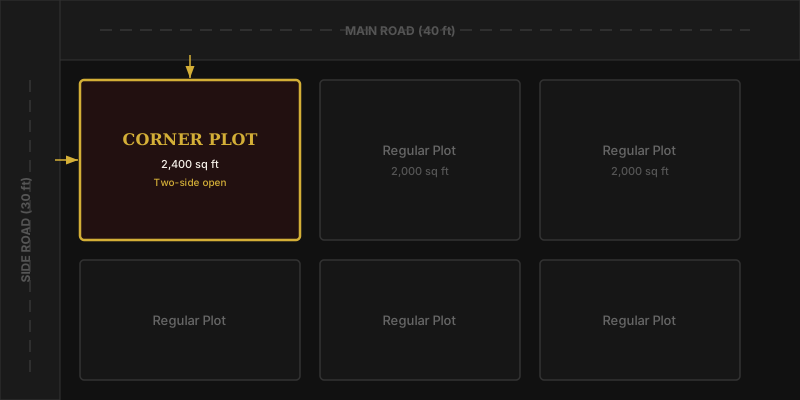
This is the first and most critical check. Every approved layout has a master plan that marks open spaces, utility zones, parks, and road widths. The corner plots nearest to utility zones (transformers, water pump houses, sewage treatment plants) are always the first to lose value when construction begins. Ask the developer or the local development authority for a certified copy of this plan — not a marketing brochure, but the actual approved drawing.
◆ Part of our Corner Plots Guide
For the remaining eleven checks, we have organized them into four categories: legal, physical, Vastu, and infrastructure. Each check has a specific action and a specific document or observation to verify.
Legal Checks: The Non-Negotiable Foundation
Check 1: Title Chain Verification
Trace the ownership history back at least 30 years. In Bangalore, the Sub-Registrar's office maintains these records. In Hyderabad, use the IGRS (Inspector General of Registration and Stamps) portal. Look for any gaps in the chain — periods where the land changed hands without a registered sale deed. Any gap is a red flag that could indicate a disputed title.
Check 2: Encumbrance Certificate
Obtain a fresh EC covering the past 13 years (the standard limitation period for property disputes in India). This document reveals any mortgages, liens, or legal disputes attached to the property. For corner plots in newly approved layouts, also check the EC for the parent property from which the layout was carved.
Check 3: Layout Approval and RERA Registration
Confirm the layout is approved by the competent authority — BDA or BMRDA for Bangalore, HMDA for Hyderabad, LDA for Lucknow, DTCP for Gurugram. If the project has more than eight plots or exceeds 500 sq metres, it must be RERA-registered. Cross-verify the RERA number on the respective state portal.
Check 4: Khata and Tax Records
In Karnataka, verify both A-Khata and property tax paid receipts. Many buyers dismiss B-Khata properties entirely, but a B-Khata in a BDA-approved layout can be converted to A-Khata — the real danger is properties with no khata entry at all, which suggests the layout may not be regularized. In Telangana, verify the property is reflected in the Dharani portal records.
Physical Checks: What the Ground Tells You
Check 5: Boundary Survey
Hire a licensed surveyor to place boundary stones and verify measurements against the approved layout plan. Corner plots are especially vulnerable to boundary disputes because they adjoin two roads and often a public open space at the corner vertex. Survey costs range from 15,000 to 25,000 rupees — a negligible expense for a plot costing three crore or more.
Check 6: Monsoon Drainage Test
Visit the plot during or immediately after heavy rain. Corner plots sit at the junction of two road drainage channels, and if the storm water drain design is faulty, water from both roads converges at your corner. In Bangalore's Whitefield layouts, we have seen corner plots where 15 centimetres of standing water accumulates during heavy October rains because the junction drain was undersized.
Check 7: Soil Quality Assessment
If you plan to build within two years, invest 20,000-30,000 rupees in a geotechnical soil test. This reveals the soil bearing capacity (critical for foundation design), water table depth, and presence of any fill material. Corner plots in layouts carved from agricultural land occasionally have uneven soil profiles where one side was cut and the other filled.
Check 8: Road Width Verification
Measure the actual road width on both sides of the corner plot. Compare with the approved layout plan. In many developing layouts, roads are built narrower than approved, with the developer promising to widen later. For premium homes, both roads should be at least 40 feet (12 metres) to allow comfortable access for luxury vehicles and guest parking.
Vastu and Orientation Checks
Check 9: Compass Orientation
Use a reliable compass (not a phone app, which can be inaccurate near construction sites) to determine the exact orientation of both roads. A northeast corner — where roads run along the north and east sides — is the most auspicious Vastu position. Document the orientation precisely because it determines your entire home's floor plan and entrance placement.
Check 10: Surrounding Structure Heights
Check what has been built on adjacent plots. If the plots to your south and west have multi-storey structures, they will cast shadows that affect both your solar gain and Vastu energy flow. For a premium corner plot, the ideal scenario is lower structures on the south and west sides and open roads on the north and east.
Infrastructure and Future-Proofing Checks
Check 11: Utility Infrastructure Proximity
Walk the layout and identify where transformers, water tanks, sewage treatment plants, and waste collection points are positioned. In most layouts, these are placed near corners because corners offer access from two roads for maintenance vehicles. A transformer within 30 metres of your plot creates electromagnetic concerns, noise, and visual blight. Verify with the layout plan that no such installation is planned adjacent to your corner.
Check 12: Neighbourhood Build-Out Rate
Count how many plots in the layout have completed or under-construction homes. A build-out rate below 20% means you may wait five to seven years for the area to feel like a functioning neighbourhood, with corresponding delays in street lights, security, and community services. A rate above 40% suggests the layout is maturing and infrastructure will improve rapidly. In Lucknow's Shaheed Path zone, layouts that crossed the 40% build-out mark in 2023 saw a sharp 15-20% price jump within 18 months as the area became liveable.
The red soil of Tellapur clings to your shoes after the first monsoon shower — a reminder that the ground beneath a plot tells truths that no brochure ever will.