Corner plot setback rules and building regulations in India require mandatory open space on all road-facing sides of the plot, and since corner plots face two roads, they lose more buildable area than interior plots. In Bangalore, BBMP mandates 3-metre setbacks on both road-facing sides for corner plots above 2,400 sq ft, with 1.5 metres on the remaining sides. Hyderabad's HMDA requires 2-3 metre setbacks depending on plot size and building height. Lucknow's LDA mandates 3 metres on front and 1.5 on sides and rear. Gurugram's DTCP requires 3 metres on front, 2 on rear, and 1.5 on sides for most residential plots. The dual road-facing setback on corner plots reduces buildable footprint by 8-12% compared to interior plots of the same size. This is why understanding the exact setback norms before purchasing — not after — is critical for premium buyers planning homes above 3,000 sq ft built-up area. The setback area is not wasted space; it becomes driveways, gardens, and outdoor living zones that define the luxury experience.
Key Takeaways
- Corner plots require road-facing setbacks on two sides, reducing buildable footprint by 8-12 percent.
- BBMP mandates 3-metre setbacks on both road-facing sides for Bangalore corner plots above 2,400 sq ft.
- Setback norms vary significantly between BBMP, HMDA, LDA, and DTCP jurisdictions across cities.
- Building within setbacks risks demolition orders and denial of occupancy certificates in all cities.
- Setback space can be designed as driveways, gardens, and verandahs adding lifestyle value to the home.
What Nikhil's Architect Should Have Checked First
The mistake was assuming that corner plot setback rules mirror interior plot rules. They do not, and the difference is significant enough to reshape an entire floor plan. On an interior plot, only one side faces the road and requires the wider road-facing setback (typically 3 metres). The remaining three sides get narrower setbacks (1.5-2 metres). On a corner plot, two sides face roads, doubling the wider setback requirement. See our guide on corner plot advantages.
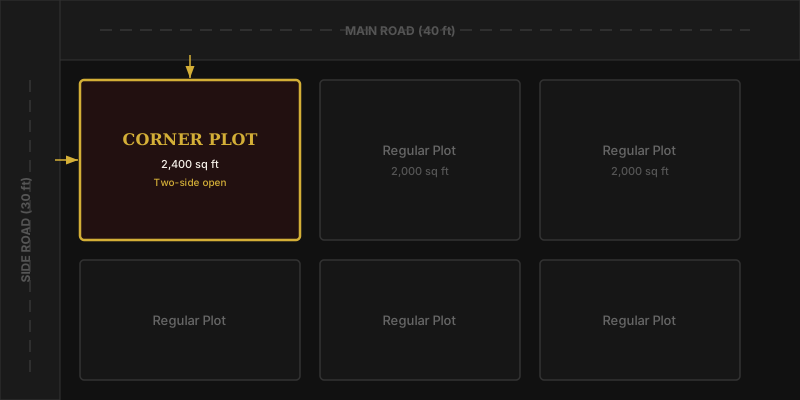
For Nikhil's 2,400 sq ft plot (40 by 60 feet), the correct setback calculation was: 3 metres on the north road side, 3 metres on the east road side, 1.5 metres on the south boundary, and 1.5 metres on the west boundary. This left a buildable rectangle of approximately 27 by 51 feet — roughly 1,377 sq ft, or 57% of the total plot area. An interior plot of the same dimensions, with only one 3-metre road setback, would yield about 1,530 sq ft of buildable area — 11% more.
◆ Part of our Corner Plots Guide
That 11% difference translates to roughly 153 sq ft per floor. Across two floors, Nikhil lost 306 sq ft of potential built-up area compared to what an interior plot buyer would get. This is real space — enough for a full guest bedroom or a large home office.
Corner Plot Setback Rules: City-by-City Breakdown
Bangalore (BBMP and BDA)
Bangalore's setback norms are governed by the Karnataka Revised Building Bye-Laws. For residential plots, the rules depend on plot size and road width:
- Plots up to 1,200 sq ft: 1.5m on all sides, 3m on road-facing sides for roads above 12m wide
- Plots 1,200-2,400 sq ft: 1.5m rear and sides, 3m on road-facing sides
- Plots above 2,400 sq ft: 3m on all sides (road-facing or not)
For corner plots, the critical rule is that both road-facing sides require the road-facing setback. On a 2,400 sq ft corner plot, this means 3m + 3m on the two road sides plus 1.5m + 1.5m on the other two sides (for plots under 2,400 sq ft) or 3m on all four sides (for plots above 2,400 sq ft).
Additionally, BBMP requires a chamfered corner (diagonal cut) at the junction of the two roads. The standard chamfer is 3 by 3 metres — a triangular area at the corner vertex that must remain open for vehicular visibility. This further reduces the usable corner area.
Hyderabad (HMDA and GHMC)
Hyderabad's setback norms under the Telangana Building Rules are slightly different. The base setback for residential buildings up to 10 metres height is 2 metres on all sides. For taller buildings (which is relevant if you plan ground-plus-two floors), side setbacks increase to 3 metres.
Many Hyderabad architects and buyers believe that HMDA's 2-metre setback is more lenient than Bangalore's 3-metre requirement — but in practice, Hyderabad's height-linked setback scaling means that a two-storey home on a corner plot ends up with the same or stricter effective setbacks once the building exceeds 7 metres in height.
Lucknow (LDA)
Lucknow Development Authority mandates a 3-metre front setback (road-facing), 1.5 metres on sides, and 2 metres at the rear for residential plots up to 200 sq metres. For larger plots, setbacks increase proportionally. Corner plots require the 3-metre road-facing setback on both road sides. Lucknow's relatively generous plot sizes (many premium layouts offer 2,400-3,600 sq ft plots) mean the setback impact is proportionally smaller than in Bangalore or Gurugram where plots tend to be smaller.
Gurugram (DTCP Haryana)
Gurugram follows Haryana's building bylaws under DTCP. Standard residential setbacks are 3 metres on front, 2 metres on rear, and 1.5 metres on sides. Corner plots require the 3-metre front setback on both road-facing sides. In licensed colonies, developers may impose additional setback requirements specified in the colony's building guidelines — these are binding and cannot be reduced even if they exceed DTCP minimums.
Making Setback Space Work for You
The setback area is not wasted land — it is the canvas for everything that makes a luxury home different from a premium apartment. Smart architects design the setback zones as integrated parts of the living experience rather than treating them as regulatory dead space.
On a corner plot, the two road-facing setbacks can be designed as a wraparound verandah — a covered outdoor sitting area that follows the L-shape of the building along both road sides. In Bangalore's climate, this verandah becomes the most-used space in the home for eight months of the year, serving as a morning coffee spot, an evening reading area, and a gathering space for guests.
The driveway and parking typically occupies one road-facing setback, while the other becomes a garden or landscaped zone. The key design decision is which road gets the driveway and which gets the garden. The wider road typically gets the driveway for easier vehicle entry, while the narrower or quieter road gets the garden for a more peaceful outdoor experience.
The Chamfered Corner: Regulation and Opportunity
Most Indian municipalities require corner plots to have a chamfered (diagonally cut) corner at the junction of the two roads. This 3-by-3 metre triangle is mandatory open space intended for traffic visibility. It cannot be built upon or enclosed.
Architects have turned this regulatory requirement into a design feature. The chamfered corner becomes a natural location for a statement landscaping element — a mature tree, a stone water feature, or a sculptural planter visible from both roads. Some premium homeowners use this corner as a lit architectural feature at night, creating a distinctive address marker that distinguishes their home from every other property on the street.
The chamfered corner also creates an unusual room shape opportunity inside the building. The room nearest to the corner junction gets a diagonal wall that can be used as a feature wall with built-in shelving or an angled window seat that looks out toward both roads. Architects who work frequently with corner plots view the chamfer as a design opportunity rather than a constraint.
At Nikhil's Whitefield corner, the setback garden now hosts a jacaranda tree that blooms purple every March — three metres of mandated space that became the most photographed feature of his home.