The core vastu shastra plot selection rules for 2026 centre on four parameters: shape, slope, soil, and surroundings. A rectangular plot with a length-to-breadth ratio under 1:2, sloping gently from southwest to northeast, sitting on red or yellow soil, and free from T-junction roads or towering obstructions on its north and east sides passes the fundamental Vastu test. These rules have remained constant across centuries of practice, but their application in 2026 demands modern verification methods — topographic surveys, geotechnical soil reports, and satellite imagery for surrounding structure assessment. In premium markets like Bangalore's Sarjapur Road corridor or Lucknow's Sushant Golf City, plots that satisfy all four parameters command 20-30% price premiums and sell within weeks rather than months. Buyers investing Rs 3 Crore and above should treat Vastu selection rules as a mandatory checklist, not optional preference, because resale buyers in this segment will apply the same standards.
Key Takeaways
- Rectangular plots with length-to-breadth ratios under 1:2 satisfy the most critical Vastu shape rule.
- Southwest-to-northeast slope ensures proper energy flow and practical water drainage benefits.
- Red and yellow soils are Vastu-auspicious and structurally superior for residential construction.
- T-junction plots facing south or west carry both Vastu and practical liveability drawbacks.
- Modern tools like topographic surveys and satellite imagery make 2026 Vastu assessments more accurate.
What Priya's Soil Test Revealed About the Plot's Character
Priya had visited seventeen plots across Tellapur, Narsingi, and Kokapet before finding this one. Most failed her checklist before she even stepped out of her Mercedes GLE. One had a massive apartment tower casting afternoon shadows across the entire northern boundary. Another sat at a T-junction where the road dead-ended straight into the plot's south wall. A third was trapezoidal, narrower at the front than the back, which Vastu classifies as a "gomukhi" shape — acceptable for residential use but suboptimal for corner positions.
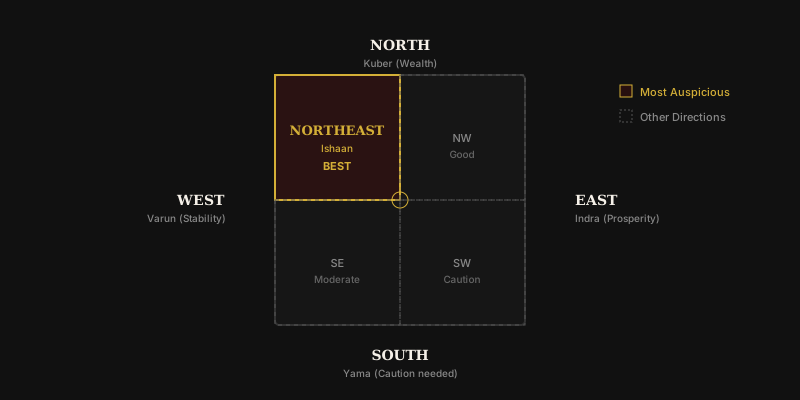
This Tellapur plot was different. It was almost perfectly rectangular, 44 feet wide and 50 feet deep. The two roads flanking it were 40 feet and 30 feet wide respectively, running along the north and east boundaries. When her surveyor measured elevation, the southwest corner stood 8 inches higher than the northeast — a textbook Vastu slope.
◆ Part of our Vastu & Compliance Guide
But the soil clinched it. The geotechnical report showed laterite soil with a bearing capacity of 18 tonnes per square metre, well above the 15-tonne minimum recommended for two-storey residential construction. In Vastu terms, this reddish soil indicated prosperity and stability. Priya made her offer that afternoon.
The Four Vastu Shastra Plot Selection Rules for 2026
Rule 1: Shape — Rectangles and Squares Only
Vastu Shastra is unambiguous about plot shape. Square and rectangular plots allow balanced distribution of the five elements across their four quadrants. When a plot is L-shaped, triangular, or has cut corners, certain quadrants receive disproportionate area, creating energy imbalances that are difficult to correct through design alone.
For premium corner plots above 1,800 sq ft, the ideal length-to-breadth ratio falls between 1:1 (perfect square) and 1:1.5. Ratios stretching beyond 1:2 create excessively elongated plots where the central Brahmasthan — the energetic heart of the plot — becomes hard to protect during construction. In Bangalore's Devanahalli layouts, plots near the airport corridor typically maintain 1:1.2 to 1:1.4 ratios, making them structurally and energetically sound.
Rule 2: Slope — The Southwest Must Stand Tallest
The ideal Vastu slope runs downward from the southwest corner to the northeast corner. This is not arbitrary. In the Indian subcontinent, the southwest receives the harshest afternoon sun and the strongest monsoon winds from June through September. An elevated southwest naturally shields the living areas, which Vastu positions in the northeast and east zones, from excessive heat and weather exposure.
Many buyers assume a perfectly flat plot is ideal, but Vastu actually prefers a slight gradient. A dead-flat plot requires artificial slope creation during construction, adding Rs 3-8 lakh to project costs depending on plot size. Requesting a topographic survey before purchase — costing Rs 8,000-15,000 — can reveal whether natural slope works for or against your design.
Rule 3: Soil — What the Ground Tells You
Vastu categorizes soils by colour, texture, and behaviour. Red and yellow soils rank highest — they indicate iron-rich, well-drained terrain ideal for foundations. White soil is acceptable. Black cotton soil, prevalent in parts of Hyderabad's outer development zones and Gurugram's southern sectors, is considered inauspicious and poses genuine structural risks through its seasonal swell-shrink cycle.
A geotechnical soil report costs Rs 12,000-25,000 and provides bearing capacity, moisture content, and composition data. For plots above Rs 3 Crore, this investment is negligible relative to the risk of foundation issues discovered after construction begins.
Rule 4: Surroundings — What You Cannot Change
Your plot's immediate environment is the one Vastu parameter you cannot modify after purchase. Tall buildings on the north or east side block morning energy and sunlight. Temples, hospitals, or cremation grounds within 100 metres carry specific Vastu implications. Water bodies to the northeast are auspicious, while stagnant water anywhere nearby is not.
In Lucknow's expanding Shaheed Path and Sultanpur Road corridors, new premium layouts are being planned with Vastu-conscious master planning — wider roads on north-south axes, parks positioned in northeast quadrants, and commercial zones concentrated in the southeast. Buyers should evaluate the master plan alongside individual plot characteristics.
How 2026 Market Conditions Affect These Rules
Premium plot markets across India's top cities are tightening. In Bangalore, BDA and BMRDA-approved corner plots above 2,400 sq ft have seen inventory drop 35% year-on-year while prices have climbed 12-18%. Hyderabad's HMDA-approved plots near the Pharma City corridor show similar trends. This scarcity means buyers face a practical tension: waiting for a plot that satisfies every Vastu rule perfectly versus securing a strong plot that meets three of four criteria and correcting the fourth through design.
The pragmatic approach for 2026 is to treat shape and surroundings as non-negotiable — these cannot be altered after purchase. Slope and soil, while important, can be modified during construction at reasonable cost. A plot with excellent shape, clean surroundings, and proper soil that slopes slightly wrong can be re-graded. A plot with a trapezoidal shape in front of a T-junction cannot be fixed at any price.
Verification Methods That Protect Your Investment
Modern technology has made Vastu plot assessment more rigorous than ever. Here are the five verification steps every premium buyer should complete before signing:
- Magnetic compass reading at all four corners to confirm true cardinal directions (smartphone compasses are unreliable near steel structures)
- Topographic survey by a licensed surveyor to map elevation across the plot
- Geotechnical soil report from an NABL-accredited laboratory
- Satellite imagery review of surrounding structures within a 200-metre radius using Google Earth Pro
- Master plan verification with the local development authority (BDA, HMDA, LDA, or DTCP) to check for upcoming construction that could affect the plot's Vastu environment
The total cost of these five steps ranges from Rs 35,000 to Rs 75,000. Against a purchase price of Rs 3-10 Crore, this represents less than 0.25% of the transaction value — a rational insurance premium for a decision that will shape your family's daily life for decades.
The laterite soil of Tellapur holds the afternoon warmth long after sundown, and if you press your ear close, you might hear the quiet confidence of ground that has waited a thousand monsoons to be built upon.